A mean–variance estimation bidirectional convolutional long short-term memory surrogate model predicting residual stress and model error for laser powder bed fusion
Jan 5, 2025·
 ,
,
,
·
0 min read
,
,
,
·
0 min read
Praveen S Vulimiri
Shane Riley
Florian X. Dugast
Albert C. To
 Graphical abstract
Abstract
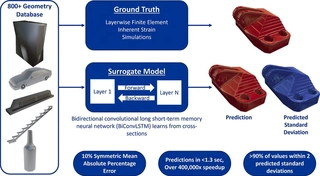
Beam-based metal additive manufacturing (AM) processes, such as laser powder bed fusion or directed energy deposition, melt and fuse the feedstock material to build a part sequentially. The repeated heating and cooling cycles introduce thermal stress, which can cause the part to distort or crack. While simulation can help predict the stress, the computational time required could take longer than manufacturing the part. In this work, a data-driven, geometry-agnostic, mean–variance estimation (MVE) model based on the bidirectional convolutional long short-term memory neural network (BiConvLSTM) is proposed to predict the residual stress and uncertainty in a few seconds of computing time. This particular neural network was chosen due to its ability to predict the residual stress based upon sequential cross-sectional layers, thereby incorporating the layerwise process in the model architecture. The model was trained for a model material using 832 geometries of varying size from the Princeton University ModelNet database, simulated using the finite element based layerwise inherent strain method. The training data consists of various unique geometries, which varies from 1 voxel up to 200 voxels in a single axis. The method was compared with a state-of-the-art U-Net architecture, where the BiConvLSTM had 75% fewer parameters but would improve performance by 10% compared with the U-Net. For unseen parts, the mean absolute error of the predicted stress is around 12% of the yield stress, and 90% of modeling errors are within two predicted standard deviations at each element. The model evaluates all examples in less than 1.3 s, achieving speedups over 20,000 times. This is ideal in applications where speed is important, such as design optimization evaluating hundreds of designs or as a final check before manufacturing.
Type
Publication
Additive Manufacturing

Authors
Recent PhD in Mechanical Engineering
Praveen Vulimiri recently completed his PhD in Mechanical Engineering from the University of Pittsburgh as part of the Ansys Additive Manufacturing Research Laboratory in October 2025. His thesis dissertation focused on including data-driven surrogate models for architectural and multiphysics constraints for topology optimization and product design. Prior to the PhD program, Praveen received his BS in Mechanical Engineering from the University of Pittsburgh in August 2019 with certificates in Simulation in Engineeering Design and in Innovation, Product Design, and Entrepreneurship. For two years, he worked as a Thermal Engineer for Iris Rover to successfully land the first American lunar rover.