Process-aware topology optimization leveraging deep learning surrogate model-based functions for laser powder bed fusion

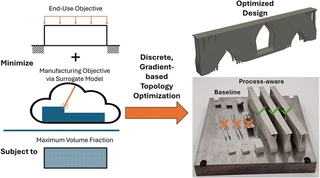 Graphical abstract
Abstract
Additive manufacturing (AM) methods have greatly matured over the years to produce complex metal parts not previously possible. One of the major methods is laser powder bed fusion (LPBF) AM, which melts and sinters powder in a layer-by-layer manner to build a part. However, during the process, the laser melting of the metal powders introduces thermal stresses that distort the part, possibly causing recoater blade interference and build failure. Topology optimization (TO) approaches have been developed to control the residual stress and distortion with geometric constraints and simplified process simulations using the finite element analysis (FEA) method. Due to computational complexity, these works ignore inelastic deformations and material nonlinearities. Indeed, early attempts incorporating these effects limit themselves to support regions or small domains for the same reason. This work enables the first computationally tractable, support-free part TO of residual inelastic deformations due to LPBF manufacturing and end-use application simultaneously. The framework leverages a data-driven surrogate model trained on elastoplastic FEA layerwise modifed inherent strain simulations for stainless steel 316L. The residual deformations and sensitivities can be calculated in seconds, easily coupling with the FEA-based end-use application and analytic maximum volume constraint. A multi-objective, discrete, gradient-based TO analysis minimizes the top surface vertical distortion at each layer alongside the end-use application, scaling to hundreds of thousands of design variables. In fact, the largest test example with over 400 iterations converged in less time than the single verification FEA simulation, 2.5 days versus 4 days. Two test examples with various overhang angle constraints are computationally verified and experimentally validated. Notably, the process-aware designs replace convex openings with columnar or thin wall supports and concave openings with teardrop-like openings. In both simulation and experiment, the process-aware designs distorted less, protruded less above the powder layer, and caused zero build failures.
Type
Publication
Additive Manufacturing

Authors
Recent PhD in Mechanical Engineering
Praveen Vulimiri recently completed his PhD in Mechanical Engineering from the University of Pittsburgh as part of the Ansys Additive Manufacturing Research Laboratory in October 2025. His thesis dissertation focused on including data-driven surrogate models for architectural and multiphysics constraints for topology optimization and product design. Prior to the PhD program, Praveen received his BS in Mechanical Engineering from the University of Pittsburgh in August 2019 with certificates in Simulation in Engineeering Design and in Innovation, Product Design, and Entrepreneurship. For two years, he worked as a Thermal Engineer for Iris Rover to successfully land the first American lunar rover.